In many design cases, covering a spray area requires more than just a single spray nozzle. You have to meticulously engineer the position of the spray nozzles array. There are two main approaches: Flat Fan and Full Cone spray nozzles arrays.
Designing Layout of Flat Fan Spray Nozzles
When establishing the design layout, there are several critical elements you must consider to ensure even and optimal fluid distribution:
- Flow rate and pressure specification of the spray nozzles
- Positional arrangement and spacing of the spray nozzles
- Target coverage area dimensions
- Degree/Angle of the spray nozzle for the required coverage
- Height distance from the spray nozzles to the target floor/surface
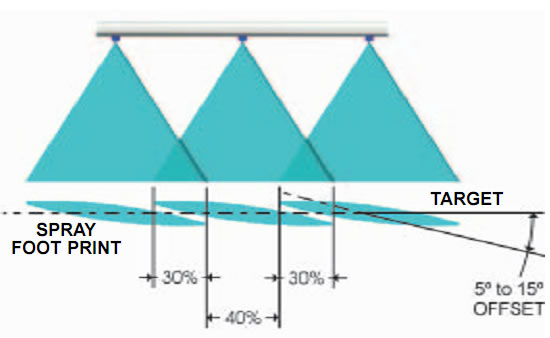
Optimal flat fan spray overlap diagram showing off-center angle positioning (usually 5°-15°) to prevent spray stream collision.
Pro Tip: Flat Fan Alignment
When you have gathered all the operational data, look at the optimal spray overlap diagram above. It's crucial that flat spray patterns are offset to avoid interference between adjacent sprays.
Designing Layout of Full Cone Spray Nozzles
Full cone nozzles distribute fluid over a circular area. When creating an array to cover a larger surface, arrangement becomes key.
- Flow rate and operating pressure of the spray nozzles
- Grid pattern positioning (Square vs. Triangular layout)
- Overall coverage area dimensions
- Spray angle and resultant spray footprint radius
- Mounting height to achieve the required overlapping intersection
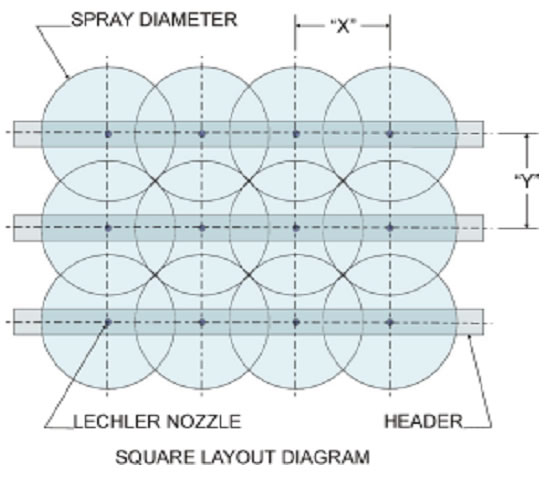
Full Cone Spray Coverage showing diagonal overlapping in a square layout arrangement.
Square layout is the easiest with minimal overlap. If strict coverage uniformity is not highly critical, this can be the most cost-effective approach. However, if the spray angles are too narrow or the header is mounted too low, the intersections at the corners can open into dry voids.